

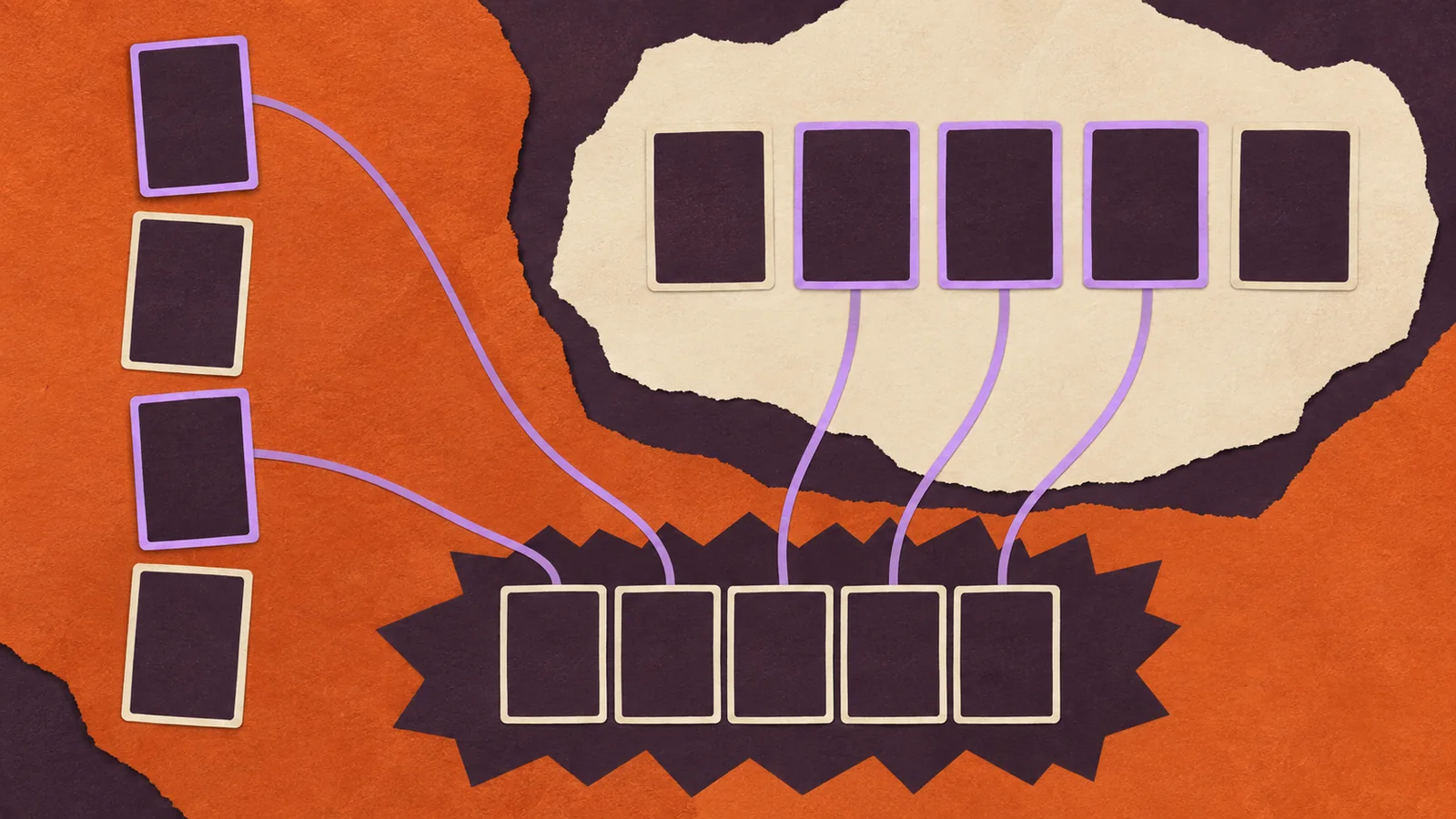
This guide uses Pot-Limit Omaha high (PLO): the highest legal five-card hand wins the eligible pot, and a raise cannot exceed the pot-limit maximum. Omaha Hi-Lo, five-card Omaha and six-card Omaha are different variants. The general types of poker games guide introduces those families; here we stay with the four-card high game and make every example reproducible.
Omaha in One Table
| Question | Four-card Omaha high | Texas Hold'em |
|---|---|---|
| Private cards | Four | Two |
| Shared board | Up to five cards: flop, turn, river | Up to five cards: flop, turn, river |
| Cards used at showdown | Exactly two private + three board | Best five from all available cards: zero, one or two private cards may play |
| Can the five-card board play by itself? | No | Yes, if it is your best five-card hand |
The last row is more important than it looks. If the board reads K♠ K♦ K♥ 7♣ 7♠, a Hold'em player may play that full house. A four-card Omaha player cannot take all five board cards; they still need two cards from their own hand and only three from the board. Never announce a hand by looking at the board alone.

The Deal, Button, Blinds, and Four Streets
The button marks the dealer position for the hand. The small blind and big blind post forced wagers to its left. Each player then receives four face-down hole cards. Preflop betting begins immediately left of the big blind and moves clockwise. If the hand continues, three community cards appear on the flop, one on the turn, and one on the river. A betting round follows each reveal. Postflop betting starts with the first player still able to act left of the button.
That sequence resembles Hold'em, but the decision is different because four hole cards create more two-card combinations. At showdown, do not pick three or four attractive hole cards; choose exactly two hole cards and exactly three board cards, then compare the resulting five-card hands. The Omaha rule sequence confirms the four betting streets and the 2+3 showdown constraint.
Blinds and antes are part of the pot calculation. The poker blinds guide explains the forced posts and seat rotation; Omaha's exactly-two-hole-card rule remains separate. A room may use different stakes, ante rules and procedures. The numerical betting example below states its pot and contributions explicitly and assumes no rake; it is a teaching calculation, not a universal blind structure.
How to Construct a Legal Omaha Hand
There are six possible pairs among four hole cards and ten possible three-card selections from a five-card board. That makes 60 candidate 2+3 selections before duplicate rank outcomes are considered. You do not need to inspect all 60 by hand during a game, but the counting rule is useful: C(4,2) × C(5,3) = 6 × 10 = 60. It describes combinations of card positions, not 60 different hand rankings or a probability of winning.
PokerNews explains the exact-two-hole-cards rule in a short English-language video. English captions are available; the worked hand below covers the details the clip does not.

At a showdown, use this three-step check:
- Pick exactly two distinct cards from your four-card private hand.
- Pick exactly three distinct cards from the five-card board.
- Name the resulting five-card hand and check whether another legal 2+3 selection makes a stronger hand.
Do not start with a five-card board result and try to justify it after the fact. That reverses the rule. It is also why a single ace in your hole cards cannot complete an ace-high board straight by itself: you would be using only one hole card.
Three Board Traps That Fool Hold'em Players
Trap 1: One Spade in Your Hand Is Not Enough for a Spade Flush
The board is A♠ K♠ Q♠ 7♠ 2♦. Your four Omaha cards are J♠ 9♥ 4♣ 3♦. A Hold'em player holding J♠ could combine it with four board spades. You cannot: in Omaha you must take two hole cards and only three board cards. Your private hand has just one spade, so any legal 2+3 selection contains at most four spades. You do not have a flush. Count the suits in the exact five selected cards before making a flush claim.
Trap 2: The Board's Full House May Not Be Yours
The board is K♠ K♦ K♥ 7♣ 7♠. Your cards are A♣ Q♣ J♦ T♦. The five community cards form kings full of sevens, but you cannot play all five. Two of your private cards plus the three board kings give you three of a kind, kings, with two kickers. This does not tell you who wins a hypothetical pot; an opponent's hole cards could make a full house or a stronger hand. It only establishes that the board's full house is not automatically your Omaha hand.
Trap 3: A Straight May Lose Its Top Card
The board is A♠ K♠ Q♠ J♦ 2♣. Your four cards are T♠ 9♥ 4♦ 3♣. A Hold'em player with T♠ 9♥ could select A♠ K♠ Q♠ J♦ T♠ for an ace-high straight. In Omaha that uses just one hole card and four board cards, so it is illegal. Your legal selection T♠ 9♥ plus K♠ Q♠ J♦ makes 9♥ T♠ J♦ Q♠ K♠, a king-high straight. Same board, different best legal hand.
These are rules exercises, not claims about how frequently the traps occur. All named cards are distinct in each example; each result follows the published 2+3 construction rather than an estimate or a strategy chart.

Pot-Limit Betting: What Does “Raise the Pot” Mean?
In PLO, an opening bet cannot exceed the pot. Facing a bet, the maximum raise calculation includes the amount needed to call first. The published PokerStars pot-limit definition adds the active pot, existing bets and the call before determining the maximum raise. Saying “pot is $150, so I can only put in $150” may understate the legal maximum because it ignores that call-first step.
Take a fresh betting street with $100 in the pot and no previous bet on the street. Player A bets $50. Player B, who has contributed nothing on this street, now faces $50:
| Step at B's decision | Amount | What it means |
|---|---|---|
| Pot before A's bet | $100 | Existing pot from earlier action |
| A's outstanding bet | $50 | Pot totals $150 before B acts |
| B's amount to call | $50 | If B calls, the pot would become $200 |
| Largest pot-sized raise increment | $200 | The raise above B's $50 call |
| B's maximum total wager now | $250 | $50 call + $200 raise |
| Pot after B puts in $250 | $400 | $100 original + A's $50 + B's $250; A must still respond |
If A then calls B's raise, A adds another $200, and the pot becomes $600 before the next card, assuming no rake. The $400 is not the pot total after A calls B's raise. By writing the decision point and the contributions separately, the example avoids the common confusion between pot size, raise increment, and total amount a player puts in.
The minimum legal raise is a separate rule. Under the same published PLO rules, a non-all-in raise increment must be at least as large as the previous full bet or raise on that street. A short all-in can affect whether a player who has already acted may raise again; the Poker TDA tournament rule on reopening action explains that distinction for no-limit and pot-limit play. Software and live-room procedures may present “pot” differently, so use the table's assumptions rather than memorizing $250 as a universal answer.

A Complete PLO Hand: Order, Pot, and Showdown
Use four seats and $1/$2 blinds with no ante or rake. Ada has the button, Bo the small blind, Chen the big blind, and Devi is under the gun. Everyone can cover the listed amounts. Devi folds. Ada raises to $6, Bo folds, and Chen calls $4 more. The preflop pot is $13: Ada $6 + Chen $6 + Bo's folded $1.
The flop is A♠ K♠ Q♠. Chen checks, Ada bets $5 and Chen calls. The pot is $23. The turn is J♦. Chen checks and Ada checks. The pot stays $23. The river is 2♣. Chen checks and Ada checks; they reach showdown with $23 in the pot.
Ada shows T♠ 9♥ 4♦ 3♣, making the king-high straight from the selection in Trap 3. Chen shows J♠ T♥ 8♣ 7♦. With J♠ T♥ and A♠ K♠ Q♠, Chen makes an ace-high straight: T♥ J♠ Q♠ K♠ A♠. Chen wins the $23 example pot. He does not have a spade flush: only one of his hole cards is a spade. All board and exposed hole cards are unique.
The pot calculation is independent of the showdown: $13 before the flop + $5 from Ada + $5 from Chen = $23; nothing is added on turn or river. The hand illustrates the danger of declaring Ada's one-hole-card Broadway while overlooking the exact-two-hole-card requirement. It does not claim Ada's bet was strategically good.

All-Ins, Side Pots, and Ties
An all-in player may have fewer chips than others. That can create a main pot they are eligible to win and, when remaining players wager more against one another, a side pot they are not eligible to win. But not every all-in produces a side pot. PokerStars' side-pot explanation ties it to additional betting by other players. To calculate one, list each player's contribution, cap the all-in player's eligible share, and keep the excess among players who can still contest it. Do not invent a side pot merely because one stack is short.
At showdown, the high hand is still chosen by the same 2+3 rule for each eligible pot. If players' best legal five-card hands tie, the eligible pot is split according to the applicable room rules. The worked hand above has no all-ins, side pots, rake or split pot; those cases need separate contribution ledgers rather than a guess from a simplified example.
Omaha High Is Not Omaha Hi-Lo
This article uses high-only PLO: the strongest eligible high hand takes the pot unless high hands tie. PokerStars distinguishes Omaha Hi-Lo as a split-pot variant with a possible low side. The exact two-hole-plus-three-board construction still matters there, but qualifying low hands and split-pot procedures require their own explanation. Do not apply a Hi-Lo payout to the high-only examples on this page.
Similarly, “four-card Omaha” is a scope statement, not a claim that every game labeled Omaha deals four hole cards. Five-card and six-card Omaha variants exist. Check the room's game label and betting structure before using this guide as a rules reference.
Check Your Hand or Calculate a Pot-Size Raise
For a hand, say out loud: “Which two of my private cards, which three board cards, and what five-card hand do they make?” For a pot-size raise, ask: “What is in the pot now, how much must I call, and what is the pot after that hypothetical call?” If the answer depends on unstated antes, rake, stacks or an all-in, pause and write those contributions down.
The hand rankings reference supplies the rank order, while the poker variants overview separates Omaha from other games. This page's card-selection and pot-limit examples are reproducible only under the assumptions stated next to them; operator rules decide live disputes.
Source and Scope
- PokerStars: How to Play Omaha Poker — primary operator explanation for four-hole-card Omaha, exactly two hole plus three community cards, betting streets, pot-limit sizing and the distinction from Omaha Hi-Lo. The worked card and pot examples above are original calculations from those rules, not examples copied from the operator.
- PokerStars: Poker Terms and Rules — operator explanation for side-pot eligibility and tied pots.
- Poker TDA: Rules, Procedures, and Addendum — tournament reference for short all-ins and reopening action in pot-limit play; individual room procedures still govern their games.
No claim here says Poker-Eye supports a particular Omaha room, that a strategy wins money, or that one room's procedures apply everywhere.
About the Editorial Team
The Poker-Eye Editorial Team researches, checks, and maintains product and educational content. Sources and product boundaries are reviewed before publication.