

That order matters. A good decision can lose, and a bad one can still get there. The review is useful when it improves your next decision, not when it invents a tidy story about why someone else dragged the pot.
What Poker Hand Analysis Should Answer
Before you open a tracker, equity calculator, or solver, make sure the review can answer five practical questions:
- What were the format, positions, effective stack, pot, and relevant reads?
- How did both ranges change from preflop to the decision street?
- Is your hand value-betting, bluffing, bluff-catching, or denying equity?
- Which lines and sizings would you genuinely use at the table?
- Would your conclusion survive if the river and showdown stayed hidden?
If the line only looks obvious after you see villain's hole cards, you are reviewing the result, not the decision.
1. Start With the First Uncertain Decision
Mark hands during play whenever you are unsure about a call, fold, raise, or bet size. Those spots deserve attention before routine hands, unavoidable coolers, or the biggest pots in the session. If one hand contains several rough decisions, begin with the earliest one. A loose call on the flop can turn the river into a guessing game that never needed to happen.
Write down the question while it is still sharp. “Should I call this turn?” gives you something to study. “How did I lose with top pair?” mostly invites a bad-beat recap.
2. Record the Hand Before You Interpret It
Keep observations separate from conclusions. “A tight reg opened the lojack and used a large turn size” records what happened and what you knew. “Villain always has it” skips the work and locks the range to one convenient answer.
Hide the river and showdown while you reconstruct an earlier street. Lock in your reasoning first, then peek at the result. That stops later cards from rewriting the information available when you acted.
3. Rebuild the Action Street by Street
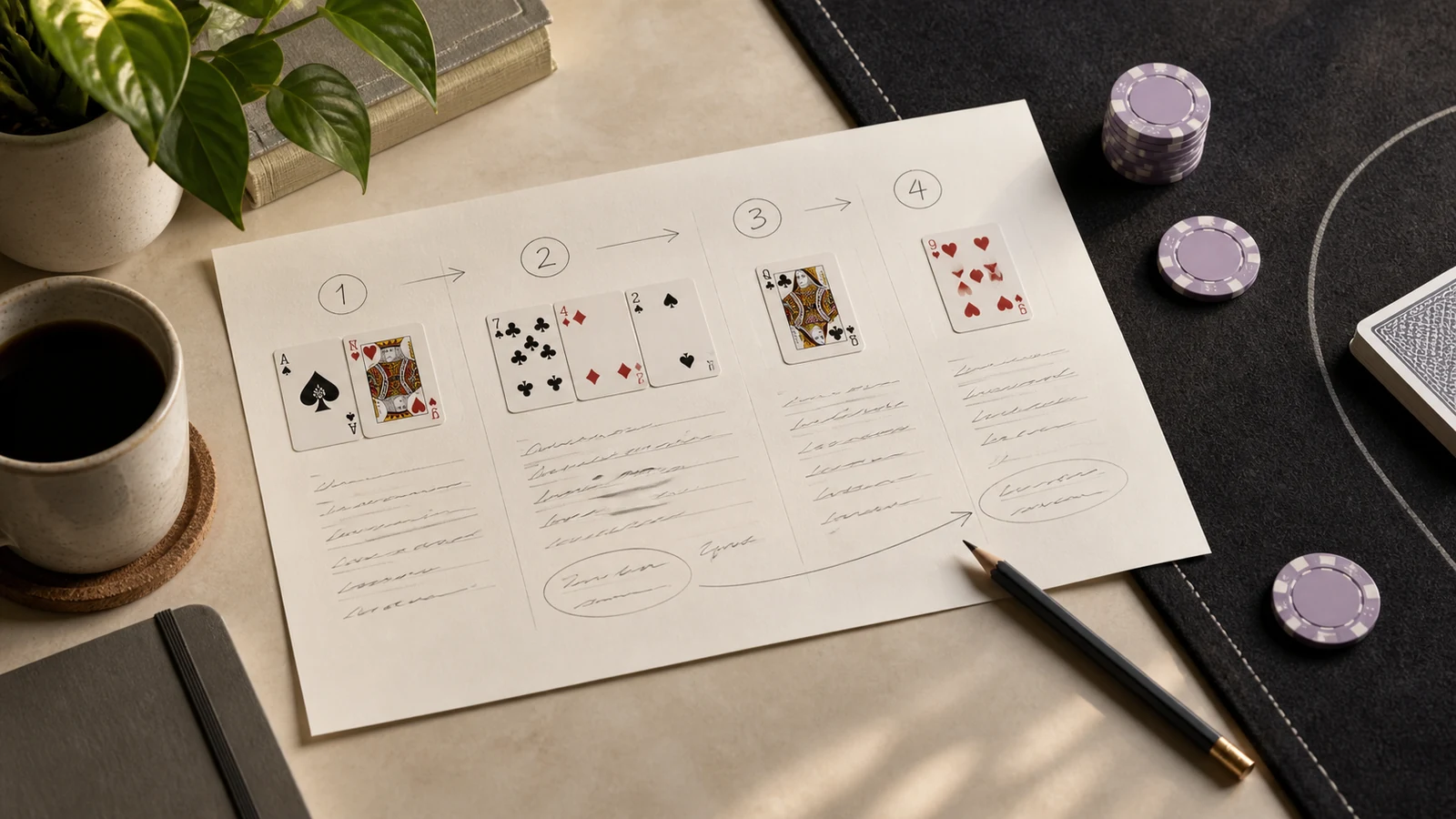
Run the hand back in order: preflop, flop, turn, river. After every action, update the pot, effective stack, available sizings, and the holdings each player can still have. Check the arithmetic before you talk strategy. One wrong pot size corrupts every later percentage, stack-to-pot ratio, and solver input.
Ask what each action removes from a range and what it leaves behind. A check does not always mean weakness; a call does not freeze a player on one pair; a big turn barrel does not magically erase every bluff. The point is to narrow plausible holdings without writing the ending first.
4. Estimate Ranges, Not One Exact Hand
Start with the hands that can plausibly take the preflop line, then narrow that set as every bet, check, call, or raise adds information. Apply the same discipline to your own range. If an argument works only for your exact two cards, it may not describe a coherent strategy.
Group what remains in a way that helps the decision: strong value, medium-strength showdown hands, bluff-catchers, draws, and bluffs. Count specific combos and blockers when they can change the comparison between lines. Otherwise, do not bury a clear spot under fake precision.
An odd showdown is still useful. Note it as evidence about that player or pool, then decide whether future ranges should move. One surprise hand is a read to track, not permission to rewrite everything you believed before the cards were exposed.
5. Compare Realistic Lines and Bet Sizes
List the actions you would genuinely consider at the table. Depending on the spot, that might be a check, a call, two practical bet sizes, or a jam. You do not need twelve nearly identical solver sizes to learn from one hand.
For each line, ask what it is trying to accomplish:
- Value: Which worse hands continue?
- Fold equity: Which better hands can fold?
- Equity denial: Which overcards or draws get there too often if you check?
- Range interaction: Who has more strong hands on this board, and which blockers matter?
- River plan: What does the pot look like after this size, and which rivers change your action?
If you use a solver, enter the pot, stacks, ranges, and betting options carefully. Read the output as a strategy for the scenario you built—not as a verdict you can paste onto a different game tree.
Look past the highlighted action. Study which groups bet, check, call, raise, or fold, and why the strategy mixes. Then ask whether the opponent model resembles the players in your game. A beautiful solve against an opponent who does not exist is still a poor guide to the pool you face.
Separate Decision Quality From the Result
State your preferred line before looking at the outcome. Judge it by the information and expected value available at the time, not by who won the pot. If your bluff got snapped, that does not automatically make it a punt. If a thin call happened to be good once, that does not make every future bluff-catch mandatory.
Use the showdown to update the model, not the grade. Record the hand, note whether it looks like a player-specific line or a broader pool tendency, and look for the same pattern again.
Use This Poker Hand Review Worksheet
Use the same short worksheet for every marked hand. Consistent fields make spots easier to compare and keep the review centered on the first real decision.
Scroll horizontally to view the full table.
| Review Item | Question | Output |
|---|---|---|
| Decision | Where did I first become unsure? | One exact decision point |
| Context | What were the format, positions, effective stack, pot, and relevant reads? | One factual setup |
| Action | What happened on each street before the decision? | Action and sizing sequence |
| Ranges | Which plausible hands remain for each player? | Short range groups |
| Options | Which realistic lines and sizes should I compare? | Two or three candidates |
| Conclusion | Which line do I prefer before seeing the result? | Choice and reason |
| Adjustment | What will I recognize or do next time? | One practical note |
Worked Example: A Difficult Turn Spot
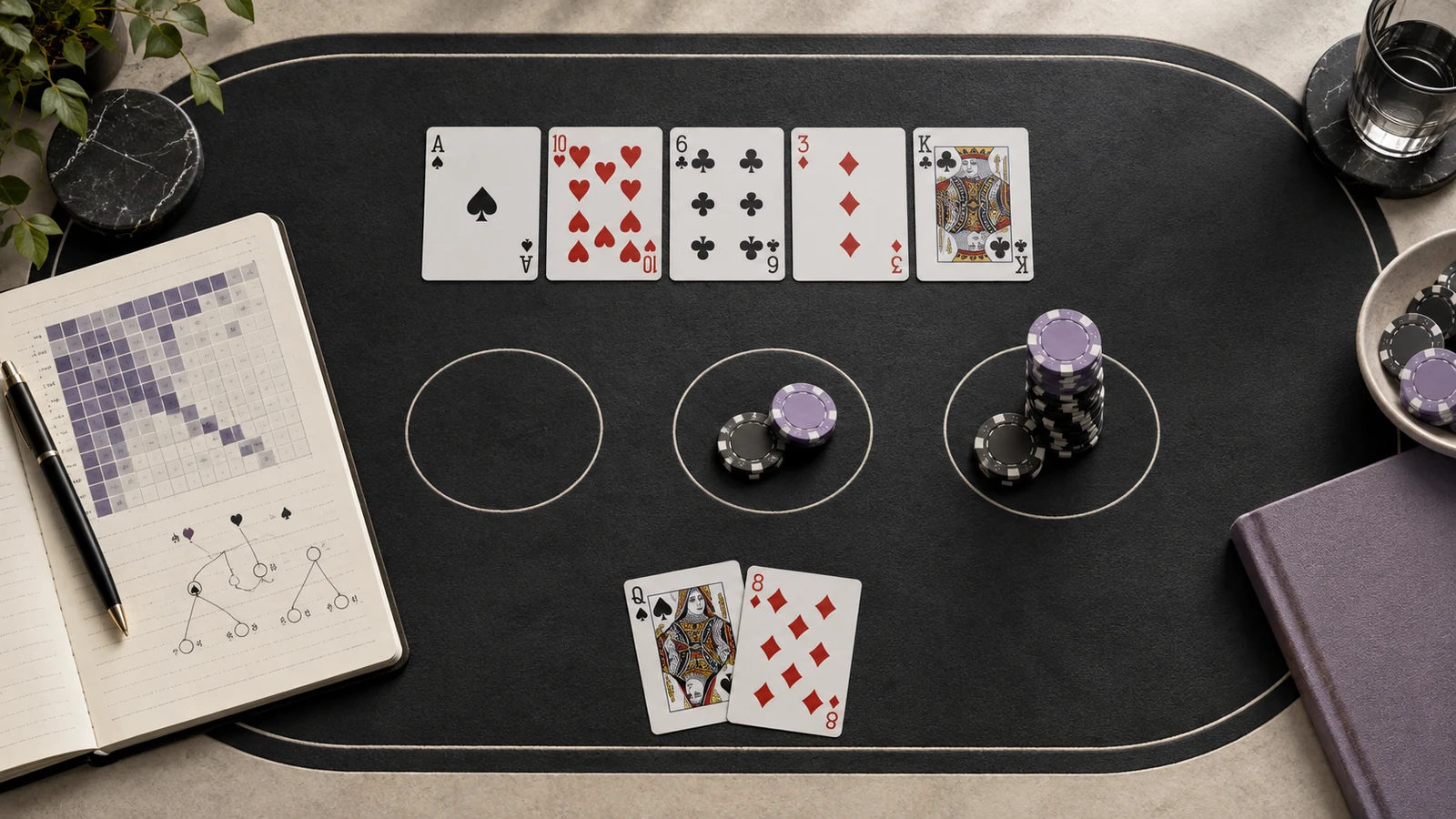
Consider an illustrative six-max cash hand played 100 big blinds effective. The cutoff opens, and the big blind calls. The flop is J♠ 8♦ 4♣. The big blind checks, the cutoff bets one-third pot, and the big blind calls. The turn is the 2♠, the big blind checks, and the cutoff holds A♠ J♦.
Do not jump straight to “top pair bets.” First rebuild the ranges that reach the turn. For this exercise, assume the big blind arrives with made hands, pairs, and draws, while the cutoff still has overpairs, Jx, sets, draws, and bluffs. Treat the A♠ as a blocker to examine in that range comparison, not as the answer by itself.
Now compare checking back, using a practical second-barrel size, and sizing up under the same assumptions. For each line, name the worse hands that continue, the hands that may fold, and the river plan created by the size. The example does not claim an optimal action or exact EV; those conclusions need a complete, reproducible scenario.
Keep the takeaway narrow: account for how the 2♠ and the A♠ blocker change the big blind's range before choosing your barrel size. That is a cue you can recognize in another hand even when the board and hole cards are different.
Common Poker Hand Review Mistakes
The most common leaks in review are not exotic. They are shortcuts that make the analysis feel decisive before it has earned a conclusion.
Starting With the Showdown
Seeing villain's cards first anchors the whole range to one result. Rebuild the decision, lock in the line, and reveal the showdown last.
Reviewing Only Coolers and Huge Pots
The biggest loss is not automatically the best study hand. A cooler may contain no realistic escape, while the small pot where you clicked a river call without a plan can expose a repeatable leak.
Treating Tool Output as a Verdict
A solve is only as useful as its tree and inputs. Check the pot, stacks, ranges, available sizings, and opponent model before you trust the clean-looking output.
Finishing Without an Actionable Note
“Play better on turns” will not help when you are back in the tank. Write one specific adjustment that tells you what to notice and which decision to revisit.
Which Hands Should You Review First?
Start with the hands that have the highest learning value:
- Pots where you went into the tank or ended up guessing.
- Recurring spots such as big-blind defense, three-bet pots, or river bluff-catches.
- Hands where your sizing had no clear target.
- Unexpected showdowns that challenge your range assumptions.
- Repeated small and medium pots that may reveal the same leak.
Do not build a study queue from coolers and spectacular punts alone. A small leak that repeats every session can matter more than one ugly stack-off.
Five Questions to Ask During a Hand Review
Sometimes the quickest way to catch a weak assumption is to hear the reasoning out loud. The five questions are already at the top of this guide; now watch Phil Galfond work through a hand and compare how he frames the decision with your own worksheet. Then run one marked hand through the process before you continue.
Turn One Review Into One Adjustment
End with a note short enough to use in your next session. “Check turn more” is too vague. “Against this pool, pause before bluff-catching the river after the turn size narrows the value range” gives you a pattern to recognize and a decision to revisit.
Tag related hands for later review. One marked hand gives you a focused question; a group of tagged hands tells you whether the same spot keeps coming up. That is how a one-off mistake becomes a leak you can actually fix.
Where Poker Tools Fit Into the Process

PokerTracker 4 can tag hands for review and compare hand equity against an opponent's range. A solver answers a different question: it compares strategies under the inputs and opponent model you give it. Neither tool rescues a vague question or a broken hand history.
Poker-Eye serves another part of the workflow. During supported play, it reads the current table context and available opponent information, then displays an action cue over the poker-room interface. You can configure the cue's size, color, and position.
In guidance mode, you decide whether to follow the displayed action. In automatic mode, Poker-Eye can click the corresponding supported action. The in-play cue does not replace off-table hand-history review; use the process in this guide to revisit uncertain spots after the session.
Sources
- Upswing Poker: Hand Reading in Poker for decision-making from the information available during the hand.
- SplitSuit: Free Poker Hand Analysis and Reviews for the distinction between decision quality and short-term results.
- PokerCoaching: How to Effectively Review a Hand History for uncertain-decision review, general solver strategy, and opponent-model checks.
- BlackRain79: How to Effectively Conduct a Poker Session Review for marking trouble hands and building a review queue.
- GTO Wizard: Solver Glossary for the scenario inputs that define a solve.
- PokerTracker 4: Product Tour for hand tagging and range-equity tools.
- PokerCoaching: We Are in the Fake Poker Solver Era for practical bet-size trees and reading the strategy behind a solve.
- PokerCoaching: How Most Players Misuse Poker Blockers for card removal and blocker-aware range work.
- Phil Galfond: Top 5 Questions I Ask Myself Every Poker Hand for the expert hand-review video included above.
- Poker-Eye Poker AI Product Guide for the current in-play product workflow and its boundary with off-table review.
Poker involves financial risk. No tool or strategy guarantees a result. Check local requirements and the current rules of the poker room you use.
About the Editorial Team
The Poker-Eye Editorial Team researches, reviews, and maintains product and educational content. Learn how the team works and which standards guide publication.