


The useful question is not “Are the stacks deep?” It is “How much additional net money must I win, on average, when the draw succeeds, and which hands will actually pay it?” A stack is a ceiling. A future payoff is a conditional expectation. Treating those as the same amount can make a losing chase look profitable.
What Implied Odds Add to Pot Odds
Direct pot odds compare the current call with the pot after that call. They are cleanest when no later decisions change the return. Implied odds add a future cash-flow model: when you make the winning hand, the opponent may pay another bet. That additional payment belongs on the winning branch, weighted by how often that branch occurs and how often it gets paid.
GTO Wizard's “Direct vs. Implied Odds” shows this extension by first calculating a losing direct-odds call, then solving for the extra money needed on the next street. The framework does not turn every draw into a call. It identifies the future value the call would need to recover its current shortfall.
Keep the task separate from the pot odds guide. That page owns the current price. Here the focus is the uncertain money still to come: the amount available, the chance of receiving it, and the possibility that improving costs more instead of winning more. Those are additional assumptions, not hidden corrections to the current pot.
Define the Pot, Call, and Future Payoff
Use one decision-point convention. P is the pot after the opponent's current bet but before your call. C is the amount you must call now. p is the probability of the modeled winning outcome on the next card. X is the average additional net money collected from the opponent after this call, conditional on that winning outcome. X does not include the current pot, your current call, or the return of your own future bet.

The first model has deliberately strict limits: one future card; every modeled hit wins; misses lose only the current call; no profitable bluffs or unimproved wins; no ties, rake, or later losses; and enough chips to cover the proposed future action. Once a condition fails, expand the tree rather than forcing the new situation into the same formula.

Suppose the old pot was $40 and the opponent bets $20. Now P = $60 and C = $20. After calling, the pot is $80. If you later bet $40 with the winning hand and get called, your own $40 returns as part of the pot; it is not an extra $40 profit. The new money won from the opponent is $40, so that paid outcome has X = $40 and a net gain of P + X = $100 from the current decision point.
Calculate the Extra Money Needed
In the bounded model, a win returns a net gain P + X, while a miss loses C. Therefore EV(call) = p(P + X) − (1 − p)C. To find the required future payment, set EV to zero and solve: pP + pX − C + pC = 0, so X = C/p − P − C. The formula only has meaning for p greater than zero.
SplitSuit explains the implied-odds formula and a $10 payoff-gap example in this English-language excerpt with English captions. The calculation is conditional on the assumed equity and payoff; it does not establish that an opponent will pay, and it omits rake and later losses.
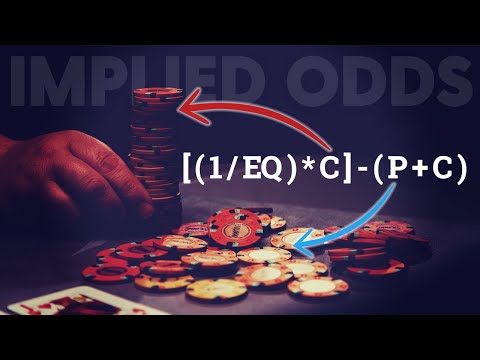
Use an original turn worksheet with P = $60, C = $20, and assumed p = 20%. Without future money, EV = 0.20 × $60 − 0.80 × $20 = −$4. The post-call pot is $80, so the direct break-even chance is $20/$80 = 25%. A 20% winning chance falls short under these assumptions.
Required X = $20/0.20 − $60 − $20 = $20. Check it in the outcome equation: 0.20 × ($60 + $20) − 0.80 × $20 = $16 − $16 = $0. The call needs an average of $20 extra on its winning branch merely to break even. It needs more than $20 for positive EV in this no-rake, no-later-loss model.

That distinction matters. The required future value averaged over all attempts is pX = 0.20 × $20 = $4, exactly the direct-odds shortfall. You do not need $20 on every attempt. You do need the successful attempts to produce $20 on average, because four out of five attempts in this model lose the current call and receive no future payout.
| Original Input Model, P=$60 and C=$20 | Direct Call EV | Algebraic X Needed for Zero EV | Interpretation |
|---|---|---|---|
| p = 15% | −$8.00 | $53.33 | Needs a substantial average winning-branch payment |
| p = 20% | −$4.00 | $20.00 | Base worksheet |
| p = 25% | $0.00 | $0.00 | Already break-even without future money |
| p = 30% | +$4.00 | −$13.33 | No extra money is required; the negative algebraic value is not a payment target |
| p = 9/46, only if this is a justified winning probability | −$4.35 | $22.22 | Exact probability changes the required payoff; a draw-completion count alone does not justify p |
The last row shows the effect of using a precise input rather than rounding to 20%. It does not declare that every nine-card flush completion is a winning out. In a real hand, cards can be blocked or dirty, and the opposing range can change their probability. Use the actual winning-outcome probability from your chosen model; poker hand probabilities provides the broader probability context.
Effective Stacks Limit the Payoff
Future money must still be available to win. Stack depth and the opponent's willingness to put chips in both matter; GTO Wizard's stack-depth discussion explicitly treats the potential to win or lose later chips and warns about opponents shutting down on draw-completing cards. Deep stacks increase capacity, not certainty.
In a heads-up pot, define S as the smaller remaining stack after the current call. That is the maximum additional amount Hero can win from this opponent in later matched action; PokerStars' table-stakes rules limit players to the chips in play and the pots their chips cover. If the required average X is $20 but S is only $15, the simplified winning-branch model cannot earn enough even if the opponent always pays the full $15. A promise to “win the stack when I hit” cannot overcome a stack that is too small.
If S = $40, collecting the entire $40 half the time and nothing the other half gives X = $20. If the same $40 payment occurs only 30% of the time, X = $12 and the base call's EV is 0.20 × ($60 + $12) − 0.80 × $20 = −$1.60. The size of the possible payment has not changed; its frequency has.

More generally, if your future value bet is V and gets called with probability c on the winning branch, while a fold produces no additional payment, then X = cV. Required c is X/V when V is positive and the assumptions hold. A required X of $20 with V = $40 needs a 50% call rate. With V = $80 it needs 25%, but the larger bet may get a very different response. Do not hold c constant merely because the formula accepts it.
Keep the stack timing exact. If Hero and the opponent each have $60 behind immediately before Hero calls $20, Hero has $40 and the opponent has $60 after that call. The remaining effective stack is $40. Record each actual remaining stack after the call and use the smaller one. “We started 100 bb deep” is not enough to determine the money still available at this decision.
Draw Visibility and Opponent Ranges
A completed draw can change both your hand and the opponent's willingness to pay. The PokerBank's examples contrast a more disguised straight with a conspicuous four-to-a-straight board. This is a reason to examine future responses, not a guarantee that a hidden draw gets paid or an obvious draw never does.
An original comparison makes the visibility question concrete. Hero 8♦7♣ on 6♥5♠K♣ can make a straight on a 4 or 9. Hero K♦4♣ on Q♥J♠T♣ can also complete an immediate straight on an ace or 9. In the second case, the next card would put four connected ranks on the board, and many opposing hands can recognize the danger. The two draw labels alone do not tell you which range pays how much.
The opponent's present strength also has two effects. A strong made hand may have more reason to pay a later bet, but it can also redraw or already dominate the hand you make. A weak range may pay little when the draw arrives, yet sometimes let you win unimproved. Do not improve the implied-payoff assumption while ignoring the corresponding change to p or to future losing branches.

For a useful range note, write which hands pay: “Top pair may call a small river bet on this runout,” or “A set can continue, but paired-board rivers may beat my flush.” Then estimate the weight of those hands and the size they pay. “Villain is sticky” is too vague to connect to a required $20 conditional average.
Dirty Outs and Reverse Implied Odds
Reverse implied odds describe the downside when later action makes a seemingly strong or improved hand expensive to hold. Sometimes you make the second-best hand; sometimes an opponent outdraws you and wins additional bets. GTO Wizard's “Reverse Implied Odds” discusses both mechanisms. Those losses need explicit branches rather than a vague subtraction from an optimistic payoff.
First distinguish a dirty out from an unpaid clean hit. If a draw completes and you win only the current pot, the extra payment is zero but the win remains a win. If it completes and you lose, the probability of the winning branch was overstated, and you may lose more than the current call. Those are different changes to the model.
Consider a synthetic extension of the $60-pot/$20-call worksheet. Suppose the draw completes 20% of the time. In an optimistic version, 12% of all attempts complete and win an extra $40, 8% complete and receive no extra payment, and 80% miss and lose only $20. EV is 0.12 × $100 + 0.08 × $60 − 0.80 × $20 = +$0.80. Here the average extra payment conditional on completion is $24.
Now discover that two percentage points of the unpaid-completion branch actually make a second-best hand and lose another $40. The final branches become 12% paid wins, 6% unpaid wins, 2% improved-but-losing hands, and 80% misses. They still sum to 100%, but EV is now negative:
| Expanded Original Outcome | Probability of All Attempts | Net Result From Current Decision | EV Contribution |
|---|---|---|---|
| Draw Completes, Hero Wins, Opponent Adds $40 | 12% | +$100 | +$12.00 |
| Draw Completes, Hero Wins, No Extra Payment | 6% | +$60 | +$3.60 |
| Draw Completes, Hero Loses Current $20 and Another $40 | 2% | −$60 | −$1.20 |
| Draw Misses, Hero Gives Up | 80% | −$20 | −$16.00 |
| Total | 100% | — | −$1.60 |
The apparently small change costs $2.40 of EV: those 2% of outcomes move from a +$60 net win to a −$60 net loss, a $120 swing multiplied by 0.02. The original completion probability remains 20%, but the winning probability is now 18%. Calling that entire 20% “clean equity” would hide both the lost current pot and the extra future loss.

Rake is another possible cost. Under a hypothetical rule that deducts R only from a pot Hero wins, the simple model becomes p(P + X − R) − (1 − p)C. The required X rises by R under exactly that fee convention. Real games can use different caps, rounding, and eligibility rules; apply the actual schedule to each branch rather than adopting this teaching assumption as a room policy.
One-Card and Two-Card Models
The required-payoff formula above is a one-next-card model. On the turn, there is only the river left. On the flop, however, a call normally does not buy an unconditional free river. If you miss the turn, you may face another bet. If you hit the turn, the river may change the winner. Both paths need a model before a two-card draw percentage can justify the flop call.
For example, a fixed set of nine qualifying cards has a 34.97% chance to appear at least once by the river in the 47/46 information model. That is not automatically the p for a flop implied-odds equation. It might require another call on many turns, include hits that later lose, or omit backdoor wins. The denominator and the event must match the actual decision tree.
An all-in call can guarantee access to the remaining cards, but in a heads-up pot it also removes the opponent's capacity for later matched bets. There is then no additional payment X to collect from that opponent after the call. Evaluate the all-in with the existing eligible pot and exact showdown equity; do not combine “all-in access to both cards” with an imaginary future stack payoff.
If another opponent remains with chips, side-pot eligibility and future action make the model multiway. PokerStars' “The Pot” states that only side-pot contributors can win it. Calculate who can win each pot and which player can supply each future payment. Money behind one opponent is not automatically available to a short stack in another pot. The simple heads-up ceiling and formula are not a replacement for that accounting.
A Worked Decision Worksheet
Start with the current price: P includes the opponent's bet; C is your new call; the post-call pot is P + C. Identify the event behind p, including cards, ranges, known blockers, and whether the hand really wins when it improves. Then calculate the direct-odds EV before considering future money. This gives you a visible shortfall rather than a vague reason to keep drawing.
If the shortfall is negative, solve for X and compare it with the remaining effective stack. Translate X into a plausible future line: the proposed value-bet size, the hands that call it, the chance of receiving no extra payment, and any risk of losing more. Test a lower payout frequency or a smaller clean-win probability. If the call needs every optimistic assumption at once, write that limitation into the conclusion.
| Simplified Assumption | Evidence or Check Needed | If It Fails |
|---|---|---|
| Every Counted Hit Wins | Exact hands or a defensible range model | Split clean wins from dirty improvements |
| Misses Lose Only the Current Call | A credible plan for later action | Add later calls, bluffs, or other receipts |
| Opponent Can Pay X | Remaining effective stacks after the call | Cap the payoff at the available matched money |
| Opponent Will Pay X on Average | Runout-specific range and response assumptions | Weight paid and unpaid winning outcomes |
| No Later Losing Investment | Check dominated draws and redraws | Add reverse-implied-odds loss branches |
| No Rake or Fees | The applicable game rules | Deduct costs on the branches where charged |
| One Card Resolves the Model | Decision street and access to later cards | Use a multi-street tree if necessary |
Keep the eventual result out of the initial review. Getting paid once does not prove that the average payment was realistic; missing once does not disprove it. Record the assumptions first, then use repeated observations to refine the uncertain inputs without claiming that one showdown validates the whole model. The hand-analysis guide keeps that review tied to the information available when you called.
Implied odds are most useful as a discipline for asking what a call still needs to earn. The required future amount is calculable under a bounded model. Whether the game will supply it remains a range, stack, and action question. Keep both parts in view before turning future possibilities into present spending.
Sources and Calculation Notes
- The PokerBank — “Implied Odds”, “Differences Between Implied Odds and Pot Odds,” the visibility examples, and “Calculating Implied Odds.” Supports future-payoff terminology and the distinction between estimating a payout and calculating a requirement. No publisher date was visible. Checked October 28, 2026.
- GTO Wizard — “Visualizing Implied Odds” (June 20, 2022), “Direct vs. Implied Odds,” “Reverse Implied Odds,” and “How Implied Odds Relate to Stack Depth.” Supports the future-value extension, downside branches, and stack/payment constraints. Checked October 28, 2026.
- Upswing Poker — “What Are Implied Odds? How to Use Implied Odds Like a Veteran Pro”, “How Do Implied Odds Work?” and “Big Blind vs. Button.” Supports the practical distinction between money remaining and the frequency of actually collecting it. The fetched related-post card identifies November 13, 2018; a main article publication timestamp was not visible. Checked October 28, 2026.
- PokerStars — “The Rules of Poker”, “Table Stakes and All-in” and “The Pot.” Supports table-stakes limits and pot eligibility. No publisher date was visible. Checked October 28, 2026.
The formulas, $60/$20 worksheet, payoff-frequency tests, sensitivity table, and expanded second-best-hand tree are original calculations, not observed hands or solver outputs. The starting p values and future responses are explicit teaching assumptions. The source examples and their numerical recommendations are not reused.
About the Editorial Team
The Poker-Eye Editorial Team researches, checks, and maintains product and educational content. Sources and product boundaries are reviewed before publication.