

In a $1/$2 hand, an allowed $4 UTG straddle makes $4 the live price facing players who have not yet invested chips. It also moves the first preflop decision to the seat left of the straddler while the straddler normally gets a final option if action comes back. The PokerStars straddle explainer describes this common pattern and stresses that casinos set their own rules.
Do not confuse the straddle with a mandatory big blind or an ordinary raise made after seeing your cards. The blinds are required by the table; the straddle is an extra choice that must be allowed and declared under that table's procedure. This article models one live UTG straddle in a cash-game hand. It does not assume every room, tournament or online table offers it.
A Third Blind for One Hand, Not a New Table Limit
Without a straddle, $1 and $2 are the small and big blinds. A player with no chips invested can call $2 if nobody has raised. With the hypothetical $4 live UTG straddle, the initial cost for an uninvested player becomes $4. Ben's $1 small blind and Chen's $2 big blind do not disappear; both are still in the pot and count toward their owners' next decision.
The straddle is posted before the straddler looks at their cards. That matters: a player cannot wait to see pocket aces and then retroactively declare a UTG straddle. The table may restrict which seat may post, how much, when to announce it, whether multiple straddles are allowed, and what happens if action changes. Ask the dealer before putting out chips, particularly if the button or a Mississippi variation is proposed.
| Question | Ordinary $1/$2 hand | Illustrative live UTG straddle |
|---|---|---|
| Required blinds | SB $1; BB $2 | SB $1; BB $2 still posted |
| Extra voluntary blind | None | UTG posts $4 before looking |
| Initial uninvested cost to enter | $2 | $4 |
| First preflop player to act | UTG | First active seat left of UTG straddler |
| Last live-blind option if action returns | Big blind | UTG straddler, under the stated house procedure |
| First postflop player | First active seat left of button | Still first active seat left of button |
The last line prevents a common positional mistake. The straddler can act last preflop in the standard UTG version but does not acquire the button. On later streets, the normal button-relative order still matters. See poker positions for the regular seat map and poker blinds for mandatory posts.

Who Acts, and Why the Straddler Gets an Option
In the standard UTG version, action starts immediately left of the straddler and moves clockwise around the table. The small blind and big blind then decide whether to fold, call the difference or raise. When action returns to the UTG straddler, their $4 is already in the pot. If no one has raised, the straddler may normally check the live bet or raise; if another player raised, the straddler decides how to respond to that larger price.
The Poker Bank compares a traditional UTG straddle with a Mississippi variant in English. English captions are available. Confirm table-specific action order with the dealer.
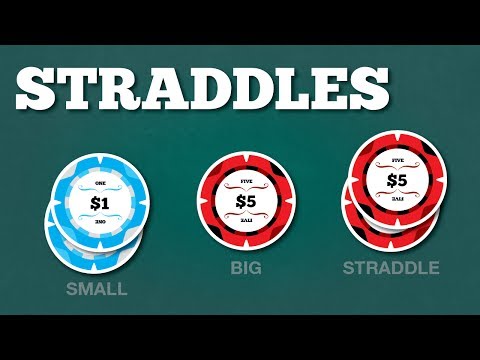
This resembles the big blind's option in a hand without a straddle, but it is not permission to ignore house rules. The PokerStars explanation says an allowed UTG straddler is last to act preflop. Stones Gambling Hall's venue explainer likewise distinguishes a traditional UTG straddle from button and Mississippi versions. Those other variants can reorder action differently, so do not use the UTG diagram to settle a button-straddle dispute.
The useful question is not “who is under the gun normally?” but “where does this table's straddle rule start preflop action?” Once the straddle is live, later players must account for it. If the straddler folds to a raise, the $4 already posted stays in the pot, just as a folded blind's chips do.
Two Parallel $1/$2 Hands: Without and With the Straddle
These are mechanical examples, not strategic recommendations. There are six seats clockwise: Ava (button), Ben (small blind), Chen (big blind), Dana (UTG), Eli (hijack), and Farah (cutoff). There is no ante, rake or all-in, and stacks cover all wagers. Farah opens to three times the live price in each scenario: $6 without a straddle, $12 with a $4 straddle. The scenarios intentionally change which blind/straddler continues, so compare the price and contribution ledger, not the strategic quality of the two hands.
| Action | No straddle | Live $4 UTG straddle |
|---|---|---|
| Posts before cards | Ben $1 + Chen $2 = $3 | Ben $1 + Chen $2 + Dana $4 = $7 |
| First action | Dana folds; Eli folds | Eli folds; Dana waits for action to return |
| Farah's open | Raises to $6 | Raises to $12 |
| Ava on the button | Calls $6 | Calls $12 |
| Ben and Chen | Ben folds; Chen calls $4 more, $6 total | Both fold; their $1 and $2 remain in the pot |
| Dana's final preflop action | Already folded | Calls $8 more, $12 total |
| Pot at end of preflop | $6 Farah + $6 Ava + $6 Chen + $1 Ben = $19 | $12 Farah + $12 Ava + $12 Dana + $1 Ben + $2 Chen = $39 |
The with-straddle pot is $20 larger here, but not because the $4 straddle alone magically added $20. The live entry price doubled and Farah's chosen open and the two calls also doubled. If Farah chose a different size or fewer players called, the result would change. The final totals reconcile from individual seat contributions; no blind or straddle is counted twice.
Without the straddle, Dana gets the first preflop decision. With Dana's live straddle, Eli gets it. After the flop, action reverts to the first active seat left of Ava's button: Chen in the no-straddle scenario, Dana in the with-straddle scenario. Ava remains last among these active players postflop in both.

“Effective Blind” and Stack Depth
A $4 straddle in a $1/$2 hand commonly makes the live price for that hand twice the posted big blind. A player with a $200 stack still has $200. Relative to the posted $2 big blind, that is 100 big blinds. Relative to the $4 straddle unit, it is 50 units. Calling the stack “50 straddles deep” can help explain why a $12 open and a $39 preflop pot feel much larger, but it does not change the official $1/$2 table label or guarantee any particular pot size.
| Comparison | Arithmetic | Meaning |
|---|---|---|
| $200 stack in posted big blinds | $200 ÷ $2 = 100 bb | The table's stated big blind remains $2. |
| Same stack in live straddle units | $200 ÷ $4 = 50 | A one-hand comparison unit, if the $4 straddle is live. |
| Pot at end of the two examples | $19 versus $39 | Specific action choices, not an automatic property of all straddled pots. |
The straddler is also putting money in blind. Acting last preflop lets them see the other players' initial actions, but being first or early on later streets can still be uncomfortable. There is no source-backed promise that straddling is profitable. The educational point is how price, action order and stack-to-pot relationships change; the decision to straddle depends on room rules and the player's risk limits.

UTG, Mississippi and Button Straddles Are Not Interchangeable
The UTG version is the reference example on this page. Some venues also describe Mississippi or button straddles, but eligibility and preflop action can differ. A button straddle in particular raises an action-order question: does action start with the small blind, the next uninvested seat, or a different house-defined position? Do not assume the UTG action order applies. Ask for the venue's written rule or a floor ruling.
| Variant name | What the name signals | What to verify at this table |
|---|---|---|
| UTG | Extra live post from the seat left of the big blind | Timing, amount, last preflop option, re-straddles |
| Mississippi | Broader eligibility than only UTG at some venues | Eligible seats, precedence if multiple players declare, action order |
| Button | Extra post from button if allowed | Who acts first preflop, how blinds respond, whether a button straddle has priority |
These are questions, not a catalog of universal rules. Even the minimum or maximum amount can vary. PokerStars' overview says a $4 straddle is a common $1/$2 example, then directs readers to check the casino. The table's current policy controls the live hand.
For a concrete published procedure, BCLC's Texas Hold'em rules with the Mississippi option allow a button straddle in that named game and put the small blind first to act. That is BCLC's rule for this option, not an instruction to start with the small blind at every table that uses the word “button.”
Before Posting: A Five-Question Floor Check
- Is a live straddle allowed in this game and on this particular hand?
- Which seat may post it, and when must it be announced?
- What amount is legal, and can someone re-straddle?
- Who acts first preflop, and does the straddler retain a live option when action returns?
- Does any special rule affect the blinds, button or later streets?
If the answers are unclear, do not move chips forward and infer the rules afterward. A straddle is a live wager with real cost, not a decorative table ritual. For the surrounding mechanics, the beginner Hold'em guide explains ordinary preflop and postflop order; this page isolates the optional extra blind. It makes no claim that Poker-Eye or a named poker room currently offers a straddle feature.

Sources and Scope
- PokerStars Learn: What Is a Straddle in Poker? — explains the common live UTG third-blind pattern, $1/$2-to-$4 example and venue-rule variability; this editorial explainer is not a universal room policy.
- Stones Gambling Hall: What Is a Straddle? — venue-authored description of traditional UTG, Mississippi and button variations; confirm a specific current table procedure separately.
- BCLC Rules of Play for Table Games, Section 17 — a specific published Texas Hold'em-with-Mississippi procedure for button eligibility and first preflop action; not a rule for other venues.
The $19/$39 pots and 100/50 stack-unit figures are explicitly defined examples and reproducible arithmetic, not observed casino results or a prediction of earnings.
About the Editorial Team
The Poker-Eye Editorial Team researches, checks, and maintains product and educational content. Sources and product boundaries are reviewed before publication.