

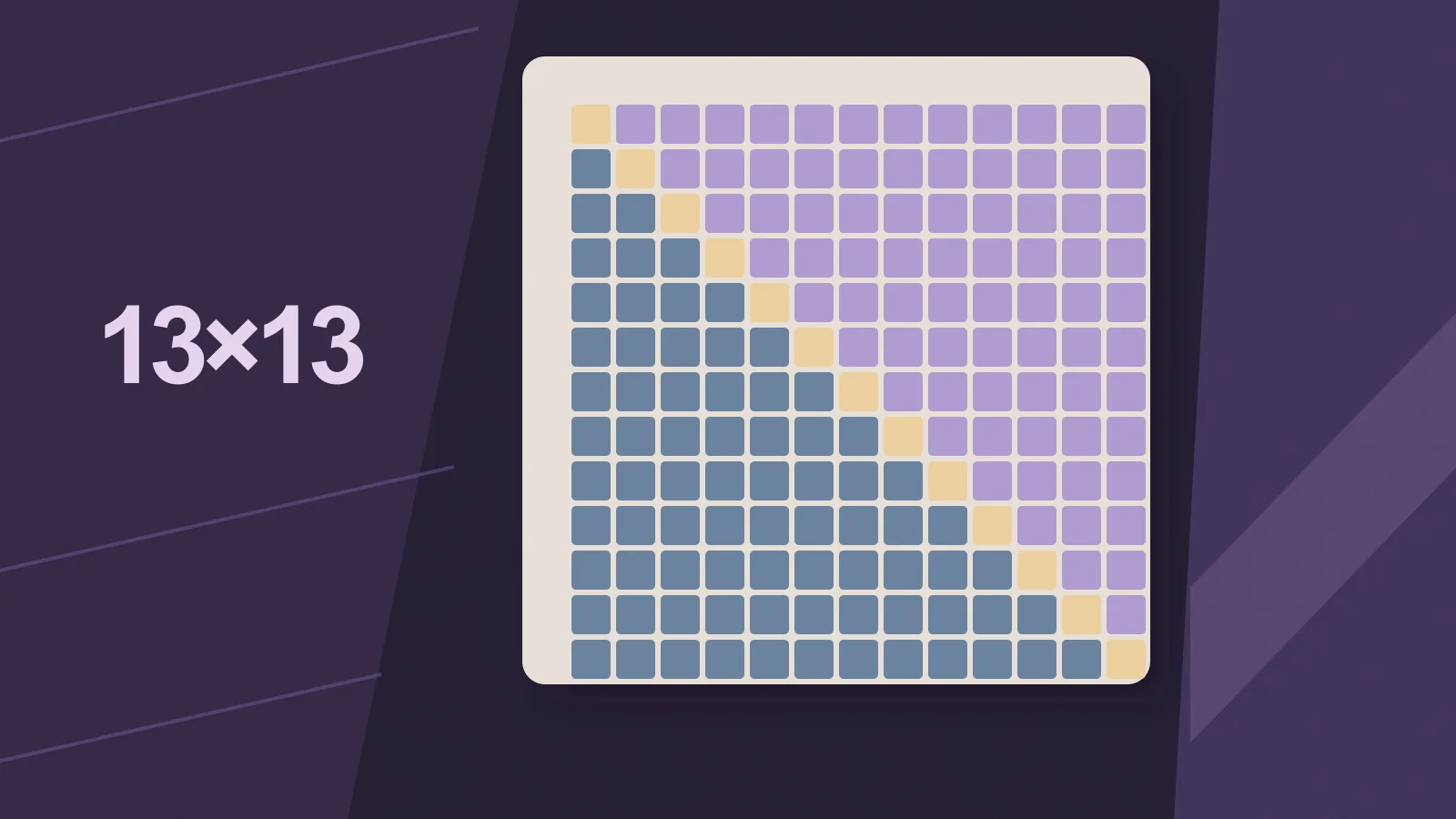
The uncolored notation grid below contains all 169 hand classes. No square claims that a raise, call or fold is optimal. If you need colored opening decisions by seat, use the publisher's nine-handed, 100-BB RFI charts alongside this guide. This page explains how to read and check such a chart; it does not republish the publisher's ranges or treat them as universal advice.
Read the 13×13 Matrix Before Reading Any Colors
The diagonal contains pairs from AA through 22. Above it, each two-rank pairing appears as a suited class marked s; below it, the same ranks appear as offsuit marked o. In the accompanying CSV, AKs is above the diagonal and AKo below. A paired cell has six exact suit combinations; an unpaired suited cell four; an unpaired offsuit cell 12. A square therefore does not represent the same number of physical hands as every other square.
| Chart label | Read it as | Example exact cards | Fresh-deck combos |
|---|---|---|---|
JJ | Two jacks | J♠J♦ | 6 |
KQs | King-queen, same suit | K♥Q♥ | 4 |
KQo | King-queen, different suits | K♥Q♣ | 12 |
KQ | Ambiguous unless chart defines it | Could include both above classes | 16 if both meant |
The arithmetic checks the grid: 13 pair classes × 6 = 78 exact pair combos; 78 suited classes × 4 = 312; 78 offsuit classes × 12 = 936. The total is 1,326, matching C(52,2). PokerStars' preflop chart lesson uses the s and o notation; its chart has its own assumptions and should not be copied wholesale into a different game. When you know specific cards, such as your own hole cards while estimating an opponent's range, some of the opponent's theoretical combinations are blocked. Fresh-deck counts are therefore a starting point, not conditional probabilities for a live hand.
The 169-Class Notation Grid — Not an Action Chart
Read the rank on the left and the rank at the top. The diagonal is pairs; cells above it are suited; cells below it are offsuit. The wide grid should remain scrollable or zoomable on a narrow screen so its labels stay legible. It shows which hand class you hold, not what to do with it.
Scroll sideways to compare all starting-hand cells.
| Rank | A | K | Q | J | T | 9 | 8 | 7 | 6 | 5 | 4 | 3 | 2 |
|---|---|---|---|---|---|---|---|---|---|---|---|---|---|
| A | AA | AKs | AQs | AJs | ATs | A9s | A8s | A7s | A6s | A5s | A4s | A3s | A2s |
| K | AKo | KK | KQs | KJs | KTs | K9s | K8s | K7s | K6s | K5s | K4s | K3s | K2s |
| Q | AQo | KQo | QJs | QTs | Q9s | Q8s | Q7s | Q6s | Q5s | Q4s | Q3s | Q2s | |
| J | AJo | KJo | QJo | JJ | JTs | J9s | J8s | J7s | J6s | J5s | J4s | J3s | J2s |
| T | ATo | KTo | QTo | JTo | TT | T9s | T8s | T7s | T6s | T5s | T4s | T3s | T2s |
| 9 | A9o | K9o | Q9o | J9o | T9o | 99 | 98s | 97s | 96s | 95s | 94s | 93s | 92s |
| 8 | A8o | K8o | Q8o | J8o | T8o | 98o | 88 | 87s | 86s | 85s | 84s | 83s | 82s |
| 7 | A7o | K7o | Q7o | J7o | T7o | 97o | 87o | 77 | 76s | 75s | 74s | 73s | 72s |
| 6 | A6o | K6o | Q6o | J6o | T6o | 96o | 86o | 76o | 66 | 65s | 64s | 63s | 62s |
| 5 | A5o | K5o | Q5o | J5o | T5o | 95o | 85o | 75o | 65o | 55 | 54s | 53s | 52s |
| 4 | A4o | K4o | Q4o | J4o | T4o | 94o | 84o | 74o | 64o | 54o | 44 | 43s | 42s |
| 3 | A3o | K3o | Q3o | J3o | T3o | 93o | 83o | 73o | 63o | 53o | 43o | 33 | 32s |
| 2 | A2o | K2o | Q2o | J2o | T2o | 92o | 82o | 72o | 62o | 52o | 42o | 32o | 22 |

State the Scenario That Makes a Colored Chart Meaningful
A usable position chart needs more than a hand matrix. At minimum, record variant, table size, position, effective stacks, blinds and antes, action before you, raise size, and whether rake or tournament payouts are modeled. “Open-raise from the button at 100 big blinds when everyone has folded” is a different question from “call a 3-bet in the small blind at 25 big blinds.” One color scheme cannot answer both.
For the reading exercise below, imagine nine-handed no-limit Hold'em, 100-big-blind effective stacks, no ante and an unopened pot. These details are hypothetical inputs for explaining positions, not a solved strategy. Rake, opponent responses and a solver model are unspecified, so none of the 169 cells can honestly be colored as an optimal action for this exercise.
| Assumption to display beside a chart | Value in this reading exercise | Why changing it matters |
|---|---|---|
| Game | Nine-handed no-limit Hold'em | A six-max seat map has fewer early seats. |
| Effective stack | 100 big blinds | A short-stack all-in game is not the same choice set. |
| Antes | None | Antes alter the pot before a voluntary open. |
| Prior action | Everyone folds to the hero | Facing an open or 3-bet requires a different chart. |
| Rake and player model | Not specified | No cell is labeled optimal without these inputs. |
Use this table to test the label on any colored chart you encounter. If an image omits these assumptions, do not convert its colors into a recommendation by guessing what the author meant.
To practice with a publisher's actual action charts, open RangeConverter's nine-handed, 100-BB cash-game PDF: page 3 shows raise-first-in grids by seat, and page 2 explains that the publisher simplifies mixed action frequencies. In the page-3 BTN RFI panel, KQs is orange; that panel's legend assigns orange to a 3.0-BB open and blue to a fold. Read that as what this publisher's specific chart says, not as an independently verified prescription for the hypothetical exercise below. Check its game model, opening sizes and action tree before using a particular grid; the PDF does not become our strategy merely because we link to it. Its ranges belong to the publisher. The uncolored grid in this article neither reproduces nor validates them, and an eight-handed or short-stack chart is not interchangeable with the nine-handed exercise.
Identify the Seat Before Applying an Action Chart
At a nine-handed table, the first seat to act preflop faces more players who can wake up with a strong hand than the button does after action folds around. PokerStars' starting-hands guide illustrates a tighter early-position selection, a broader middle-position one, and a wider button opening range. These are the source's broad teaching examples, not exact cell-by-cell prescriptions for our 100-BB scenario. For the precise seat names, use poker positions.
Consider AJo, AJs and AA. They differ not only in raw hand strength but in how they can make strong postflop hands and how many opponents remain to act. A chart may assign the same action to both AJo and AJs in one seat but separate them in another. It may also mix actions rather than use one solid color. The safe reading process is: identify the hand class, locate your position, verify the chart's scenario, then read its action key and frequency. Do not use a button cell as an under-the-gun instruction.

How Position Changes an Action Chart
An opening chart normally expands or changes as fewer players remain to act, but the exact hands depend on its model. PokerStars' educational discussion uses premium pairs and strong broadway hands to explain tight early play, adds more categories through middle position, and describes a wider button selection. That is useful for understanding the direction of change; it is not a source license to color a new matrix with made-up percentages. A reputable full chart should show its assumptions and ideally frequencies for mixed cells.
| Position lens | Question the chart should answer | Do not infer |
|---|---|---|
| Early | Which hands enter an unopened pot with many players behind? | That every attractive suited hand is a profitable open. |
| Middle | Which additional classes enter after fewer seats remain? | That “middle” means the same physical seat in six-max and nine-handed. |
| Late/button | Which hands can enter after most seats fold? | That button hands always remain playable if someone has already raised. |
If a chart highlights KQs for a button open when action folds to you, it does not tell you whether to call, 3-bet or fold after someone has already raised. The button may be the same chair, but the action history changes the task. Exact combinations and blockers also matter after cards and bets become known; a starting-hand grid alone cannot show them.
Facing a Raise Is a New Chart, Not Another Color on the Same One
An RFI (raise first in) chart assumes action folds to you. If another player opens, you face a raise: possible actions may include fold, call and 3-bet, subject to stack and table rules. A range that opened profitably against two blinds may not continue profitably against an early-position raiser. The PokerStars preflop lesson separates opening and responses; do not reuse RFI colors for the facing-a-raise decision.
The labels must stay explicit. Write BTN RFI, 100 BB, unopened rather than “button chart,” and BB vs BTN open to 2.5 BB rather than “big-blind chart.” If the small blind has already called or a straddle is live, the price and players differ again. Avoid merging those branches merely to save space on a graphic.

Stack Depth, Antes and Tournament Context
A 100-BB chart and a 20-BB chart may look different because a raise commits a different share of the effective stack. Antes change the pot already available; tournament payout pressure can change chip-EV decisions, as the ICM guide illustrates with a specified model. In cash games, rake matters to marginal calls and small pots. An action chart must declare which of those factors were included. “GTO” without a game tree, stack and rake/payout model is not a reproducible label.
Suppose a chart recommends a 2.5-BB open under one setup. At 100 BB, that amount is 2.5% of a 100-BB effective stack. At 20 BB, it is 12.5% of the effective stack. That arithmetic alone does not say the same hand should open or fold; it shows why copying the same action label across stack depths is unsafe. If the game has an ante, compare the posted pot before action as well. The poker blinds guide explains the forced positional posts; an ante adds another amount that the chart's scenario must specify.
A Worked Reading Decision Without Inventing an Optimal Range
You are on the button in the stated nine-handed, 100-BB, no-ante exercise and hold K♥Q♥ (KQs). Everyone before you folds. Step 1: locate KQs, not KQo; the cards share a suit. Step 2: locate the button RFI scenario rather than an early-seat or facing-raise chart. Step 3: inspect the chart legend: does the color mean a pure raise, a fold, or a mix? The linked PDF gives you one concrete answer for its own BTN RFI panel, as shown above. Step 4: inspect opening size, rake and blind responses before applying any action to your game. We have not provided an approved action-coded chart for this exact exercise, so the article deliberately does not pronounce “raise K♥Q♥” as a verified optimal solution.
Change one fact: the cutoff raises before you. You still hold KQs and sit on the button, but it is now a facing-open problem, not an RFI problem. A different chart and a different price are required. Change another fact: your effective stack is 20 BB. Even the facing-open chart from a 100-BB study may no longer apply. The worked example demonstrates which branch to read, not a simulated solver verdict.
How to Study a Chart Without Using It as a Crutch
Begin with a few common positions and ask why a category appears or disappears as action and stack change. Learn the s/o notation and the 6/4/12 combo weights, then test the chart against actual hand histories after play. If a cell mixes actions, record its frequency instead of flattening it to one command. When you review a mistake, keep the original chart version and assumptions; otherwise you cannot tell whether the player misread the chart or the chart was for the wrong game.
The hand-review process helps capture that original action and stack context before you compare it with a chart after the session.
Room rules also matter. GGPoker's current security policy explicitly prohibits referring to charts during play on its network. That policy does not establish what other rooms allow. This article is an educational reference, not permission to run a chart, solver or HUD while playing anywhere. Check the exact operator's current rules before using any in-play aid; study after the session when appropriate.

How to Judge the Quality of an Action Chart
A useful 13×13 action grid should have a source/version, a defined scenario, a legend with action and frequency, an accessible text equivalent, and a way to inspect its underlying cell data. Its labels must work without color alone. On mobile, a wide image that forces unreadable tiny text is not a usable chart; look for a zoomable or scrollable grid with row/column headers and a searchable text table. If a later strategy review changes a cell, its date and assumptions should change visibly too.
The grid above is a notation layer. It contains all 169 labels exactly once but intentionally no action colors. It identifies possible starting hands; it does not recommend which ones to open, call, raise or fold. Any action chart needs a stated format, position, stack, prior action, source and date.
Quick Answers
What does s mean on a poker chart? The two ranks share a suit, as in K♥Q♥ for KQs. o means different suits, as in K♥Q♣ for KQo.
Why does a 13×13 grid represent more than 169 deals? Each square groups exact suit combinations. Pairs have six, suited unpaired classes four and offsuit unpaired classes 12, totaling 1,326 possible Hold'em starting holdings.
Can I use the same chart at every position? No. At minimum, verify position, table size, stack, prior action, ante and the chart's source assumptions.
Is a preflop chart allowed during online play? That is a room-policy question, not a universal yes/no. GGPoker's cited policy prohibits in-play chart reference; check the current policy of the exact operator and format.
About the Editorial Team
The Poker-Eye Editorial Team researches, checks, and maintains product and educational content. Sources and product boundaries are reviewed before publication.