

A VPIP number can help organize a hand-history review, but it is not a verdict on whether someone is “good,” predictable or allowed to use a HUD. First check which hands went into the denominator, how many hands you actually observed, what table format they came from, and the room's current tool policy. A percentage without those conditions is much less informative than it looks.
Define the Numerator and the Opportunity First
For the particular PokerTracker 4-style opportunity definition used in this example:
VPIP = hands with a voluntary preflop contribution ÷ hands with a VPIP opportunity × 100%
A voluntary contribution can be a preflop call, limp or raise. Count a hand once if the player both calls and later raises in that same hand; VPIP measures hands, not the number of separate chip movements. The posted small blind or big blind by itself is mandatory and does not create a VPIP event. If the small blind completes an extra amount to call, or the big blind calls a raise, that additional decision does. An ante is another forced pre-hand contribution; it does not by itself prove voluntary entry.
The denominator is product-specific. The older PokerTracker 3 reference describes VP$IP over total hands played. PokerTracker 4's LeakTracker VPIP description instead subtracts hands where action folds to the player in the big blind—a walk—because that player had no meaningful chance to choose a voluntary entry. Its displayed formula omits clarifying parentheses; read it as (voluntary hands) / (total hands − walks), not as (voluntary hands / total hands) − walks. Other trackers and custom statistics may use different opportunity filters. Name the implementation when comparing two numbers.

What Counts—And What Does Not?
| Preflop event for the player | VPIP hand? | Why |
|---|---|---|
| Folds without adding chips | No | No voluntary contribution. |
| Posts small blind, then folds | No | The blind was forced; no additional voluntary chips. |
| Posts big blind, checks after limpers | No | The blind was forced, and the check adds nothing. |
| Receives a walk in the big blind | No; excluded from this PT4-style denominator | Everyone folded before a voluntary decision was possible. |
| Limps for the live price | Yes | The player chooses to add chips. |
| Calls a raise from a blind | Yes | The amount added beyond the forced blind is voluntary. |
| Open-raises or 3-bets | Yes | A chosen preflop raise adds money. |
| Posts a required ante, then folds | No | The forced ante is not a voluntary preflop contribution. |
For a real hand history, first separate posted money from later chosen money. If a $1 small blind completes to a $2 live big blind, the extra $1 makes that hand a VPIP event under the stated definition; the initial $1 alone would not. If a $2 big blind faces a raise to $6 and calls $4 more, that too is voluntary entry. In contrast, a big blind that checks for free after callers has invested only its forced $2.
These examples concern a standard blind game with no unusual dead posts or all-in procedure. A tracker may classify edge cases differently, and a particular room's hand-history format may omit details. Audit the underlying hands before blaming a one-point disagreement on “bad math.”
A Reproducible Synthetic 100-Hand Ledger
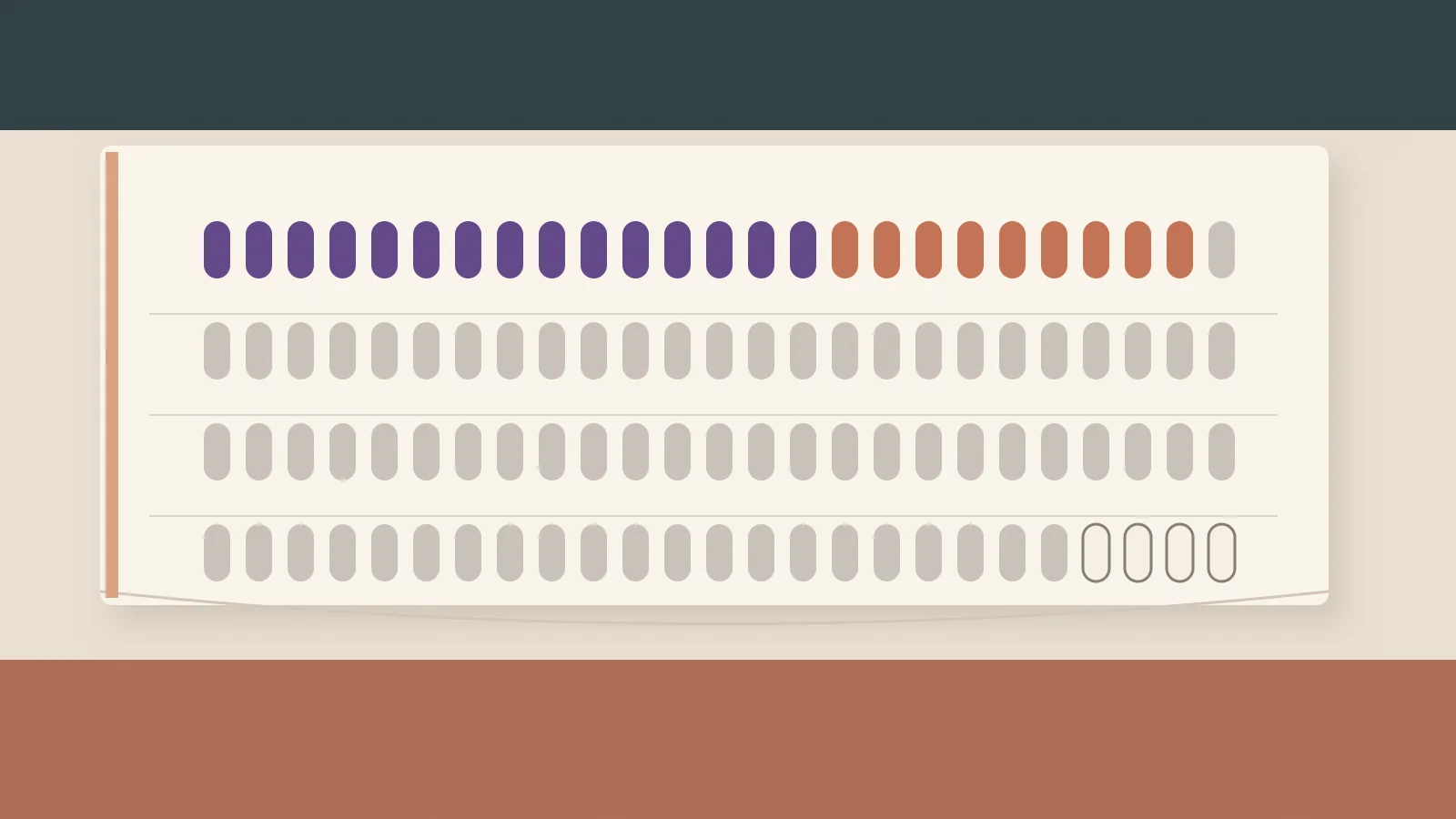
Imagine a player's 100 dealt Hold'em hands. All are in one chosen format, and the hand histories are complete. In four hands, the player is in the big blind and everyone folds: four walks. In the other 96 hands the player has a VPIP opportunity. We assign each opportunity exactly one outcome for this teaching ledger:
| Mutually exclusive hand class | Hands | VPIP numerator | PFR numerator |
|---|---|---|---|
| Voluntary preflop raise at least once | 15 | 15 | 15 |
| Voluntary call or limp, with no preflop raise | 9 | 9 | 0 |
| No voluntary contribution (fold or check after a forced post) | 72 | 0 | 0 |
| Big-blind walks, no voluntary opportunity | 4 | 0 | 0 |
| Total dealt | 100 | 24 | 15 |
The first three rows total 96 opportunities. VPIP is (15 + 9) / 96 = 24 / 96 = 25.00%. If all 96 non-walk hands also had an opportunity to make a legal preflop raise, then PFR—preflop raise frequency under that same opportunity set—is 15 / 96 = 15.625%, or 15.63% rounded to two decimals. The simple VPIP–PFR difference is 9 / 96 = 9.375%, a 9.375-percentage-point gap representing the nine call/limp-only hands in this controlled ledger. It is not proof that every real-world gap of 9.38 points consists only of limps; calls of raises and tracker-specific opportunity filters must be examined.
If someone instead divides the 24 VPIP hands by all 100 dealt hands, they get 24%. That is an arithmetically coherent different definition, not a correction of PT4's 25% in this example. If PFR opportunities are fewer than 96 because a player cannot legally raise in some hands, its denominator must be recorded separately; PokerTracker's moderator explains that a call may be legal when a raise is not. We have explicitly assumed away those extra cases in this synthetic ledger so the side-by-side comparison is reproducible.

VPIP Is Not the Same as PFR
VPIP asks whether the player voluntarily entered preflop. PFR asks whether the player raised preflop when they could. In a straightforward hand, a raise contributes to both numerators, while a call or limp contributes to VPIP but not PFR. The difference can prompt a useful question: Which hands entered without a raise, from which seats, against which prior action? The difference alone does not answer whether those decisions were good or bad.
Do not turn a VPIP/PFR pair into a personality label without checking the sample and context. A 25% VPIP across 100 qualifying hands could contain very different mixes: open-raises on the button, blind defenses against small opens, calls in multiway pots, or limps in an unusual format. Those situations do not have the same strategic meaning. A positional report or direct hand review can reveal the mix. Our poker positions guide gives the seat vocabulary. VPIP is only one metric; it does not replace a review of the underlying hands.
Sample Size: The Same Percentage Can Mean Different Evidence
Suppose one observation is 4 voluntary entries in 16 opportunities and another is 24 in 96. Both report 25%, but the smaller sample can swing much more from a handful of hands. If one of the 12 non-VPIP outcomes in the smaller sample had instead been a voluntary entry, the rate would be 5 / 16 = 31.25%. Changing one outcome in the 96-opportunity set changes the rate from 24/96=25% to 25/96≈26.04%.
Even 96 hands do not establish a permanent player tendency. Seat distribution, game format, effective stacks, opponent behavior and blind levels can all affect the decisions observed. A player dealt more buttons than early-position hands in a short sample may show a different aggregate VPIP without changing any seat-specific strategy. The same person may play six-max cash and a short-stack tournament differently. When a stat is important, segment the underlying hands before giving it a strategic interpretation; do not attach a universal “tight” or “loose” cutoff unsupported by the game and sample.

Position and Format Can Reverse a Surface Reading
VPIP from the button and VPIP from under the gun do not answer the same question. More players remain behind an early seat; a late seat has observed more folds before acting. A player's overall 25% may conceal a narrow early-position range and a wider late-position range, or it may reflect different blind-defense frequencies. Without position counts and the action faced, the aggregate rate cannot tell which explanation fits.
Table size changes the mix too. The same player at heads-up, six-max and nine-handed tables encounters different seat distributions. Tournament stages change stack depth and forced bets. Cash-game rake can affect small-pot decisions. A percentage pooled across all those contexts may be numerically correct but strategically uninterpretable. Filter by format, table size and position before comparing players or seasons; keep the hand count visible after each filter so a tidy-looking subgroup number does not hide a tiny sample.
A HUD Statistic Is Not Permission to Run a HUD
VPIP can be studied after a session in a hand-history database or displayed by a tool where a room permits it. These are different operational contexts. An explanation of the metric is not a claim that a particular application, chart or HUD is allowed during play. GGPoker's published security policy expressly prohibits external decision assistance and referring to charts during play, and its auxiliary-tool section names HUDs among prohibited decision aids. That is GGPoker's rule, not a blanket statement about every operator. Policies can change; verify the current rules of the exact room, game and client before using any in-play aid.
Nothing in this article promises that Poker-Eye or any third-party product can display VPIP on a named platform, or that a room approves that use. Do not infer product compatibility from a strategy explanation. A room's own policy is the first source for an allowed/prohibited decision; a blog post or sales phrase cannot overrule it.
How to Audit a VPIP Figure in a Tracker
- Record the product and statistic version or custom formula. Does its denominator mean all dealt hands or hands with opportunity?
- Export or inspect the actual hand set, including filters for format, seats and date. Confirm the displayed hand count.
- Count walks and other non-opportunity hands according to that implementation.
- Mark every hand with at least one voluntary preflop contribution. Do not count several raises in one hand several times.
- Recompute the numerator/denominator and compare rounding at the same precision.
- Audit PFR separately: its legal-raise opportunity count may differ from VPIP's, so do not assume the same denominator in uncontrolled data.
This workflow is valuable because it turns a percentage into a reproducible statement: “24 of 96 qualifying hands under this formula,” not merely “25 VPIP.” If the hand histories are incomplete or a room prohibits their collection, stop; do not fabricate missing opportunities to fill a chart.
For a permitted, completed-hand sample, the hand-review guide helps test what happened in context; the VPIP numerator alone cannot do that job.

Quick Answers
Does posting a blind count toward VPIP? No, not by itself. A later voluntary preflop call, completion or raise can count. A big blind that checks for free after limpers has not added voluntary chips.
Why do two programs show different VPIP for the same 100 hands? They may use different opportunity denominators, filter settings or hand-history classifications. PokerTracker's older PT3 reference and its PT4 materials illustrate why a walk can be pivotal. Recompute from the underlying hand set.
Is VPIP minus PFR a “limp percentage”? Not generally. In the controlled ledger above, the gap represents nine hands that entered voluntarily without a raise. In real data those can include calls of raises, blind completions and limps, and the two stats may have different opportunity filters.
Can VPIP predict what one opponent has right now? No. It summarizes past preflop actions across a selected sample. A current-hand inference also needs position, action, stack depth, opponent tendencies, and an honest account of uncertainty. Use the statistic to ask better hand-review questions, not to claim certainty about a hidden hand.
About the Editorial Team
The Poker-Eye Editorial Team researches, checks, and maintains product and educational content. Sources and product boundaries are reviewed before publication.